
 By Helen Wick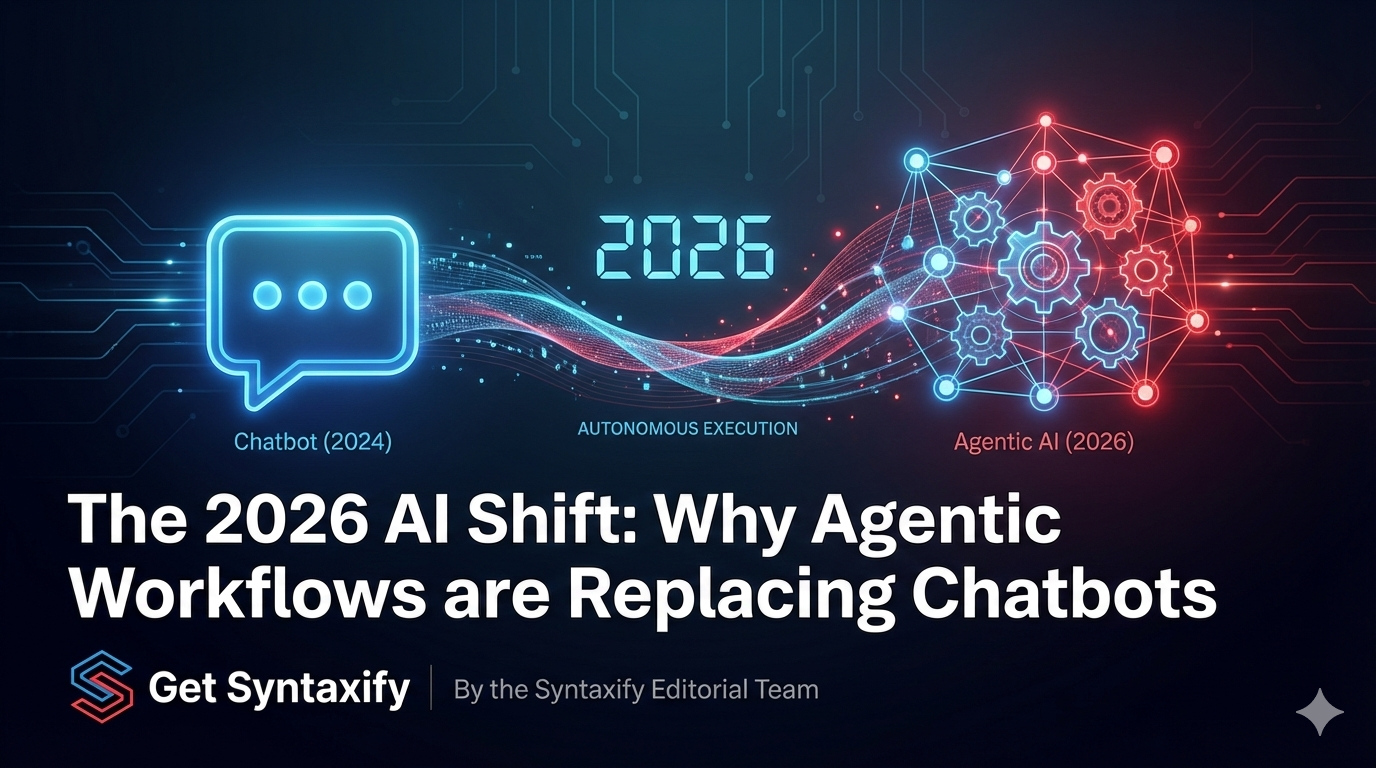
Table of contents
At a Glance (AI Summary): In 2026, the tech industry has pivoted from Generative AI (simple content creation) to Agentic AI (autonomous execution). While chatbots talk, AI Agents perform multi-step tasks, self-correct code, and manage workflows with minimal human intervention.
1. What is Agentic AI?
Agentic AI is a type of autonomous system designed to achieve high-level goals by breaking them into sub-tasks, using external tools (APIs, databases), and verifying its own results. Unlike standard LLMs that require a “human-in-the-loop” for every step, Agentic AI operates as a “human-on-the-loop,” only requiring oversight for final approval.
Chatbot vs. AI Agent: The Key Differences
| Feature | Traditional Chatbot (2024) | Agentic AI (2026) |
| Interaction | Reactive (Prompt-based) | Proactive (Goal-based) |
| Execution | Text generation only | API & Tool integration |
| Error Handling | Hallucinates without warning | Self-corrects via feedback loops |
| Workflow | Single-turn response | Multi-step task management |
2. The “50% Code” Milestone: Google’s Industrial Revolution
One of the most significant headlines in early 2026 is Alphabet’s confirmation that over 50% of Google’s production code is now written by AI agents. As a Software & AI Agency, our team at Syntaxify has observed this shift firsthand. We are no longer just “writing syntax”; we are building the logic frameworks that these agents inhabit. This shift has reduced development cycles by nearly 40%, allowing engineers to focus on high-level system architecture rather than repetitive boilerplate code.
3. The End of Hallucinations: Self-Verifying Systems
In 2026, Generative Engine Optimization (GEO) rewards sites that explain technical reliability. The “hallucination” era ended with the rise of Self-Verification Loops.
- Plan: The agent breaks a prompt into a checklist.
- Act: The agent executes code in a secure sandbox.
- Verify: A second “critique” model tests the output against the original requirement.
- Refine: If the test fails, the agent rewrites its own code before the user ever sees it.
4. Hardware and the Ambient AI Frontier
The “Digest” this month also highlights how AI has escaped the screen. Ambient Intelligence is now a standard in 2026 hardware.
- Edge Intelligence: AI agents now run locally on mobile devices using dedicated “Neural Co-Processors,” meaning your data never leaves the device.
- SMR Infrastructure: Tech giants are now deploying Small Modular Reactors (SMRs) to power the massive energy needs of global Agentic clusters sustainably.
5. Frequently Asked Questions
How is Agentic AI changing software development in 2026?
Agentic AI automates the “grunt work” of coding, such as debugging, documentation, and unit testing. This allows human developers to act as Product Architects, focusing on creativity, security, and user experience.
Is Agentic AI safe for enterprise use?
Yes. Because 2026 Agentic frameworks use Self-Verification and Sandbox Execution, they are significantly safer and more accurate than the “raw” LLMs of previous years.
Why is Syntaxify focusing on Agentic workflows?
As an agency, our goal is to build scalable, autonomous systems for our clients. By moving from simple chat interfaces to agentic workflows, we deliver software that doesn’t just answer questions—it solves business problems.